Babies and bathwater

A recent study reported in the press this week has apparently found that strict bans on mobile phones in schools have “close to zero” impact on student learning and show no evidence of improvements in attendance or online bullying. If we take such findings at face value and conclude that school phone bans are like to be ineffective, we are not only misreading the data but also misunderstanding the purpose of removing smart phones from our schools. The crucial point is not whether removing phones from the classroom instantly boosts results or turns around behaviour in schools that have problems; it is that schools have an opportunity to model healthier norms and support families in standing against what has become a tidal wave of addiction for the next generation.

The recent study cited in headlines found minimal measurable differences in academic outcomes or attendance between schools that banned phones and those that did not. Yet even the researchers themselves cautioned against interpreting this as evidence that bans are pointless. This is because educational outcomes (such as grades and attendance) are blunt instruments for measuring complex behavioural and psychological phenomena. Countless variables such as family life, socioeconomic conditions, prior attainment and curriculum quality cannot be neutralised simply by removing a device during school hours. Expecting a ban to produce immediate, measurable improvements is akin to expecting a single dietary change to transform long-term health overnight: I am currently trying to reduce my LDL cholesterol levels, and I don’t expect to see results in less than six months, nor do I necessarily expect to see them at all, as my high cholesterol may be genetic. (I strongly suspect, however, that my genetic inheritance might be a love of cheese rather than a fault in my liver’s ability to process lipids).

To understand why it is a good idea to remove smart phones from the school enviornment, let’s look at the broader research on smartphone use and adolescent wellbeing. A growing body of evidence points to significant associations between problematic smartphone use and mental health difficulties. For instance, research funded by the NIHR found that teenagers exhibiting problematic smartphone behaviours were twice as likely to experience anxiety and significantly more likely to suffer from depression and insomnia . Importantly, this research distinguishes between mere “screen time” and patterns of use that resemble addiction in the form of compulsive checking, distress when separated from the device and displacement or even rejection of other meaningful activities in favour of the device. It is this compulsive, immersive use that appears to be most harmful to young minds.

Other studies reinforce this pattern. Reviews of digital media use consistently show associations between heavy engagement and increased symptoms of anxiety, depression and isolation, while clinical research links intensive social media use even with suicidal ideation. Longitudinal studies suggest that adolescents with increasingly addictive patterns of screen use are two to three times more likely to develop suicidal thoughts over time. These findings are not trivial. They point to a behavioural ecosystem in which smartphones are not neutral tools but powerful, psychologically immersive experiences that can shape mood, identity, and social experience.

Government-commissioned reviews have noted concerns about severe harms including bullying-related distress and premature death among young people in digital environments. Parliament has examined evidence that cyberbullying via smartphones can lead to self-injurious behaviour and suicidal ideation. While causation is complex and multifactorial, coroners’ reports in the UK have increasingly referenced online experiences, including exposure to harmful content and sustained digital harassment, as contributing factors in youth suicides. Most famously thanks to her grieving father’s tireless campaigning, Molly Russell’s death was linked directly by the coroner to “the negative effects of online content”. It would be irresponsible to ignore this accumulating body of concern simply because a short-term study fails to detect immediate improvements in outcomes.

Moreover, the effects of smartphones extend beyond mental health into the texture of daily life. Young people now spend several hours a day on their devices, often displacing sleep, face-to-face interaction, and focused attention. Many platforms, driven by algorithms optimised for engagement, deliberately encourage habitual checking and prolonged use, creating feedback loops that are difficult for adolescents to regulate: frankly, they are difficult for adults to regulate. I chose to step away from social media entirely for personal use and the platforms I maintain for business I have removed from my phone, so that I can only look at them on a laptop: this helps to mitigate against their addictive nature, which is palpable and undeniable. The addictive design of social media platforms is driving a broader shift in how young people experience boredom, social interaction and cognitive effort. Schools, as institutions dedicated to learning and development, cannot simply ignore this shift, indeed they are experiencing the fallout firsthand. Ask any teacher (myself included) who has worked with young people both before and after the advent of smart phones and they will tell you: smart phones are detrimental to children’s ability to focus and concentrate. They are a net negative.

This is where the true rationale for banning phones in schools becomes clear. It is not about improving outcomes, it is about creating a protected environment in which alternative norms can be experienced and practised. Schools are one of the few spaces where society can collectively decide how young people spend their time. By removing phones, schools model a way of being that prioritises sustained attention, face-to-face interaction and engagement with the immediate environment. These are not trivial skills: they are foundational to learning, relationships and mental health, and they may not be being modelled at home.

Critics might argue that such modelling is paternalistic or authoritarian, but this fundamentally misunderstands how behavioural norms are formed. Young people do not develop their habits in isolation, they are shaped by their environments. If every space they experience, including their classroom, is saturated with digital distraction, then the idea of focused, device-free engagement will seem completely alien to them. Conversely, if schools consistently enforce phone-free environments, they can provide a counterweight to the rest of the day. Over time, this can help recalibrate expectations about when and how phones are used. Even if the measurable impact on grades is initially small, the long-term cultural effect may be substantial.

Equally important is the role that schools can play in supporting parents. Many parents currently feel overwhelmed by the challenge of managing their children’s phone use, particularly given the social pressures involved. If one child in a friendship group is allowed unrestricted access, others will quickly follow. School policies can shift this dynamic by creating a shared baseline and encouraging parents to listen to the instincts that are telling them that these devices are a threat to their children. When phones are banned during the school day, it becomes easier for parents to enforce limits at home, knowing that expectations are consistent across the community. In this sense, school bans are not isolated interventions but part of a broader ecosystem of guidance and support. The messaging becomes clear that smart phones are a cause for concern, in the same way that alcohol anc cigarettes are a cause for concern: while schools can’t prevent all children from discovering the highs that can be found via alcohol and nicotine, they can at least model the principle that these substances are problematic and undesirable.

It is also worth noting that the absence of immediate measurable benefits does not mean the absence of meaningful effects. Some studies have found improvements in classroom behaviour or reductions in distraction, even when academic outcomes may remain unchanged. These are valuable in their own right. A calmer, more focused classroom is a better environment for both teaching and learning, even if its impact on examination grades takes time to materialise. Education is not a simple input-output system: it is a complex, cumulative process.

Phone bans are not a silver bullet, they are one tool among many, to be used alongside education about digital literacy, parental guidance and broader societal conversations about technology use. Expecting them to single-handedly reverse trends in mental health or academic performance is not just unrealistic, it sets them up to fail. When the inevitable modest results appear, critics can then dismiss the entire approach, reinforcing a cycle of inaction. You throw the baby out with the bathwater.

Smartphones are deeply embedded in modern life. Schools cannot control what happens outside their gates, but they can shape the environment within them. By doing so, they send a signal about values: that attention matters, that conversation matters, that not every moment needs to be mediated via a screen. Ultimately, the debate about phones in schools is not just about education policy; it is about the kind of childhood and adolescence society wishes to cultivate. In that context, focusing solely on short-term academic metrics is a profound misreading of the issue. Schools cannot solve the problem alone, but they can play a crucial role in modelling a different way of living and learning: one that recognises both the power and the peril of the devices in our pockets.

Photo by Kamal Uddin on Unsplash

Fraud

Some things have happened to me this week that have made me reflect about how we talk to each other online. I mentioned in my last post that I had (accidentally) smashed my iPhone. This is now fixed, although not before I had been through quite the self-reflection on whether it might actually be rather good for me to own a smart phone that was less pleasant to use. In the end, however, I concluded that a broken phone was at risk of malfunctioning and that this was perhaps not the smartest move for someone who is self-employed and relies on business coming in; yesterday, I forked out for a replacement screen.

The smashed phone coincided with some broader reflections that I also mentioned in my last blog post and which have continued to ferment in my mind. Two television programmes have influenced me over the last fortnight, one a drama and one a documentary. A couple of weeks ago I got around to watching the most recent season of Charlie Brooker’s Black Mirror and was moved and disturbed as always. The final episode – without giving too much away – deals with smart phone addiction; it is a thought experiment about where such an addiction might lead in a worst-case scenario, and takes a wry look at how even the creators of the big social media platforms seem to rue their own creation.

This episode of Black Mirror really stuck in my mind and at first I struggled to think why. It wasn’t one of Brooker’s best and it certainly wasn’t one of his most disturbing. (There are other episodes of Black Mirror that I frankly regret watching). Yet this one needled me, I suspect because I recognised the compulsion and the attachment it explored. I knew that I found my smart phone addictive. So I resolved to do better, and as a part of my quest I decided to watch something else that had been on my list for a while, a Netflix documentary called The Social Dilemma. This production, made only a couple of years ago, interviews a range of ex-techies from Silicon Valley, all of whom have left the companies for which they previously worked: there was the guy who created the “Like” button on Facebook, there were techies from the platform formerly known as Twitter, from Instagram and even from Google. All of them had three things in common. Firstly, they had all struggled personally with addiction to the products that they themselves had helped to create: they were suppliers addicted to their own drug. Secondly, they were now united in opposition to the way that these platforms were built and designed in order to be addictive; many of them were actively campaigning against the platforms that they used to work for, appalled by what they themselves had created. Thirdly, not one of them let any of their kids near a smart phone. Not at all. These were wealthy tech whizzes from Silicon Valley and their own kids do not have smart phones. If that doesn’t make the rest of the world reflect on why they let their kids have access to these devices from such a young age, I don’t know what will.

There is so much to love about the internet. I find it empowering and useful and it enables me to do the work that I do. On the other hand, there is much to be afraid of, most of all the addictive nature of the ever-accessible device in your pocket. Listening to the men and women who created these platforms that we all use and hearing them explain how they are built, designed and programmed to be addictive was a sobering experience. I have found myself looking at those around me – both the people I am close to and people who are strangers to me – and I see the signs of compulsive usage everywhere. I see it in myself. To my regret, I have found myself scrolling through and staring at platforms I actively dislike, somehow unable not to look at them, even in the sure and present knowledge that they bring me no joy. Why do these things have such power over us? The answer is that they were built that way; clever people are paid a lot of money to find ever-improving ways to keep us glued to every platform we sign up to.

In response, and taking the direct advice of the self-confessed ex-drug-pushers from Silicon Valley, I have removed all social media apps from my phone. There are several platforms I viscerally dislike and would happily never use again, but they are undeniably useful for business: Instagram, Facebook and LinkedIn; these from now on I will manage solely through scheduling on my laptop, and I will log in to do that kind of work once or twice a week. The messaging services on Facebook and Instagram I have set up to deliver an automated message to anyone enquiring after my services, saying hello, explaining that I do not spend time on those platforms and giving other ways to get in touch with me. The responses to this, I can tell you, have been interesting. A couple of very genuine prospective clients have reached out to me, one even thanking me for enabling them to get off the platform, which she also disliked. Another said “good for you”. But two other people – neither of whom were prospective clients, nor were they known to me personally – have already expressed their disapproval.

When I logged in to check my Instagram account recently, I found one message from someone purporting to be a business coach. I have no interest in using a coaching service, so I would have ignored this man’s approach anyway, wherever he had made it. He sent me a message stating that he “had a question about my business” and, because it was on Instagram, he received my automated response. His immediate reaction was anger. I blocked him, obviously, but I do find myself wondering about just how bad his own addiction is that the very implication that someone else was choosing not to hang out on his platform of choice made him furious.

Further to this, it appears that another person approached me initially on Instagram and then followed this up, as instructed, with an email. This, of course, I received. He too said that he had a question, and I asked him what it was. Fortunately, it was not a ruse to send me something inappropriate, but it was an inroad into asking me to translate something into Latin for him. Now, you probably don’t realise this, but I get literally dozens of these kinds of requests. I used to respond to all of them. I still do to some. A few months ago, someone got in touch and asked for my help with a favourite quotation for their mother’s funeral and of course I replied to them, indeed I corresponded with them at some length.

Much of the time, however, especially when I am busy, I don’t honestly consider it my honour-bound duty to provide a free translation service for anyone and everyone’s t-shirt, club logo, necklace or tattoo. I am a teacher and a tutor, I’m not a motto-creation service. If someone asks nicely, I may help them out. This man, however, before I had even decided whether and how I was going to respond to his request, followed up his initial email with a second one barely an hour or so later, wanting to know whether I had received the first email and intimating that he was waiting on my response. I didn’t like this, so I decided simply to delete both the emails. The consequence of this decision was that he sent me another, one-word message on Instagram. It said “fraud”.

Fraud.

I am sure that this person is a perfectly reasonable and functioning individual in real life. Were I to sit him down face-to-face and explain that this is a busy time of year for me, that I get dozens of these sorts of requests, that I might indeed have responded to him had he been a little more patient and not harrassed me for an answer, I am quite certain that he would have reacted in a rational manner. Yet online, without that human connection, not only did he decide that I am a “fraud”, he felt the need to tell me so. How did he feel after he sent that message, I wonder? Vindicated? Satisfied? Like he’d done a good thing? Somehow I doubt it. It is an empty feeling, shouting into the void and being left to wonder what the reaction at the other end might be.

The truth is that these platforms are not good for us. They make us less honest and they make us less kind. Most of all, it seems to me, they make us lonelier by dividing us further – the very opposite, those recovered tech junkies tell me, of the original Silicon Valley dream. So you will not find me hanging out on LinkedIn, Instagram or Facebook, none of which contain anything that interests me enough to outweigh the excessive demands that they have placed on my attention due to the addictive nature of their construction. I do gain something from the platform formerly known as Twitter, as so many teachers exchange ideas on there and it remains an outstanding medium for finding links to new ideas and research about good practice in education. If Threads takes over that mantle, so be it. Still, however, I have ruthlessly removed these platforms from my phone. I will keep things on my iPad, which I do use but nowhere near as much as I use my phone. So the phone will be solely for genuine messages from real people – family, friends and clients. At the moment, as I get used to the situation, I am finding myself picking the phone up and then wondering what on earth I have picked it up for. Numerous times a day. This only goes to prove that my decision was right – clearly, the number of times I have been habitually checking these platforms for no good reason is genuinely scary.

I think what I have decided is that, like all addictive substances, social media must either be avoided altogether or be very strictly managed. Its usage must be balanced against the risks and if it’s not bringing me joy or enriching my life, then I genuinely don’t see the point of it. For some people, I fear, social media really is the same as drugs and alcohol: highly addictive, with the potential to turn them into the very worst version of themselves.
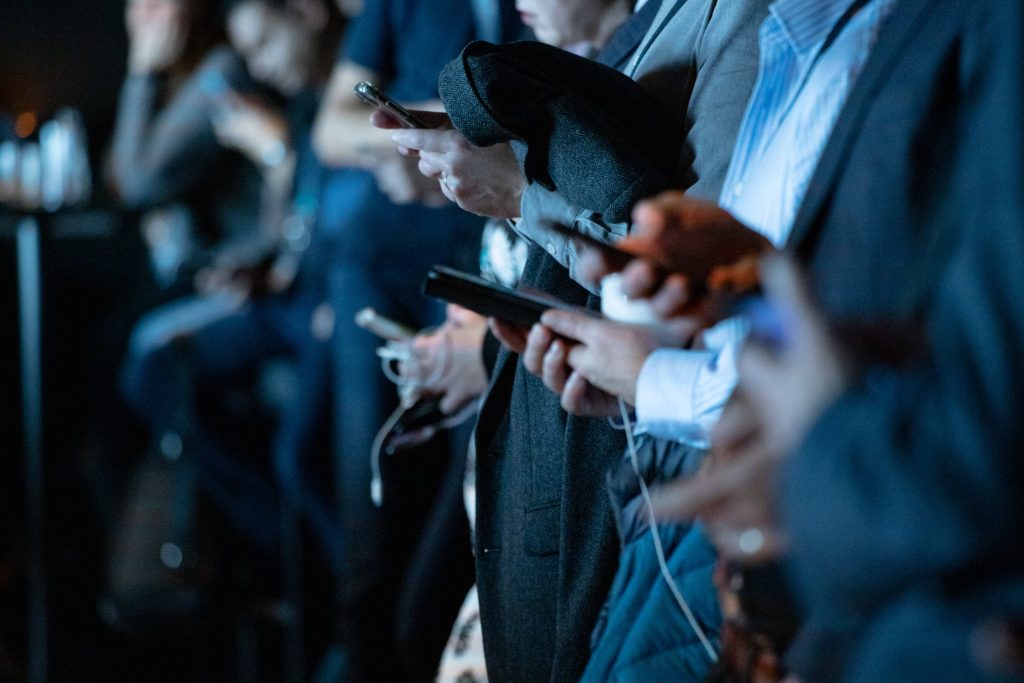
Photo by camilo jimenez on Unsplash