Emotions got a bad rap from ancient philosophers. Most agreed that the ideal state was a kind of calmness that the Hellenistic philosophers (most famously the Epicureans and the Stoics) called ataraxia. There was even talk of apatheia – a detachment from the chaos of feelings and overwhelm. This is perhaps unsurprising if you understand the birth of western philosophy; if you’re trying to formulate, define and distil the key to the perfect life and the perfect society (which is what the early founders of western philosophy were trying to do) then it probably doesn’t include your citizens experiencing a rollercoaster of emotions. Once you’ve admitted that emotions are a bit of a distraction and often cause issues both on a personal level and for society, it’s not much of an overreach to find yourself arguing for a state of detachment.
The term “stoic” these days is synonymous with having a “stiff upper lip” but this is based on a crucial misunderstanding of the Stoic position. The Stoics did not advocate for iron-clad self-control or suppressing your feelings. Rather, they believed that all emotions were what they called “false judgements”, which meant that they were based on a misunderstanding: if you’re feeling them, you’re still getting it wrong. In the ideal philosophical life that they strove for, a person would have such a great understanding of himself, the world and his place within it that he would not suffer at the slings and arrows of outrageous fortune: he would simply nod and know the right thing to do. One example given is that a Stoic would run into a burning building in order to attempt to save a child because that is the right thing to do; they also argued, however, that a true Stoic would feel no distress when his mission failed. Weird, isn’t it? Interesting, though.
One of the frustrating things about this period of philosophy is that much of the writings that we have are general “sayings”, snippets or purported quotations which appear in the works of later authors, usually writing in Latin rather than in Greek, and reporting on what a particular thinker or school of thinkers believed. The reality of this of course is that they may be wrong. For example, there is a famous quotation attributed to Epicurus that states “the wise man is happy on the rack”. Quite how this works within a school of philosophy that was dedicated to the avoidance of pain is puzzling. If the quotation is correct, our best guess is that the Epicureans certainly spent a lot of their time considering the correct attitude towards unavoidable pain, for this was one of the biggest challenges to their philosophical position; presumably the “wise man” – someone at the pinnacle of philosophical endeavour – would know how to cope with pain in extremis.
Most people see Epicureanism and Stoicism as polar opposites and they were indeed rival schools of philosophy at the time. As so often, however, there was more that united them than divided them. Both schools were arguing and aiming for the perfect life and the state of detachment that philosophers before them had explored; both schools were concerned with how to manage our responses to pain and distress. Perhaps the biggest difference is that the Stoics believed in proactive, conscious and deliberate involvement in society and its structures, whereas the Epicureans were a bit more lethargic about the whole idea – getting involved with politics is painful and distressing, so is it really rational to bother?
One philosopher, writing before the Stoics and the Epicureans, was unusual in his take on emotions. Aristotle argued that emotions were appropriate and necessary: the trick was understanding when and how you should be feeling them and what to do with them. He spoke of “righteous anger” and argued that a good philosopher would indeed feel such a thing. It is difficult to explain how truly radical this position was, when the way the philosophical movement was drifting was towards ataraxia and apatheia. Aristotle also smashed through the Socratic idea that philosophical ideals such as “courage” and “justice” could be defined in one way and that if one could not do so then one lacked an understanding of them. Aristotle argued that there were multiple forms of “courage” and “justice” and that nobody could define them in one simple way nor apply their principles in individual cases without discussion, debate and compromise. What a genius he was.
Why the hell am I writing about this? Well, I spoke to a friend yesterday who has taken a decision about which she feels guilty. I cannot divulge the details of this decision as I do not want to betray her confidence. Suffice to say that it was a professional decision, the right decision and one which the people affected will hopefully benefit from in the long-run. There is no doubt – in my mind and even in hers – that the decision was right and good. Yet she still feels what she describes as “guilty” about it.
This reminded me yet again of The Greeks and the Irrational by ER Dodds, a book written in the 1950s, which I mentioned in another blog a few weeks ago. One of the chapters in the book argues that the Athenian world was a “shame culture” and that later ancient societies – the Hellenistic world and the Roman worlds – began the shift towards a “guilt culture”. I have thought about this on and off all of my life. The very thought that the nature of one’s emotions can be dictated by the society in which one grows up is fascinating to me. Dodds argues (rightly, I think) that modern society is more person-centric and hence feelings such as guilt can be internalised; in Athens, one’s personal standing and engagement with society was more relevant (a symptom perhaps of living in a small and emergent city-state) and therefore a sense of shame before others was more powerful than any kind of internalised guilt.
As I listened to my friend who left me some WhatsApp voice messages (I love them – it’s like receiving a personalised podcast!) I found myself wondering whether the Stoics had it right. Sometimes emotions truly are false judgements. My friend has no reason to feel guilty about her actions and she should strive to release herself from the false state of mind in which this feeling distresses her. According to the Stoic ideal she has prevailed in her actions but has not yet achieved the ideal state of detachment. So how should she achieve this goal? Well, I guess it depends on your approach to these things. A Stoic would advocate for rigorous rational analysis and say that this will eventually lead to release from one’s feelings. This is not, in fact, a million miles away from cognitive behavioural therapy, the therapy model supported by psychiatrists and many psychologists, who would say that she needs to question why she feels guilty and challenge her reasons for doing so. A psychologist with leanings towards the psychodynamic model would argue that she needs to explore where her feelings might stem from – does the situation remind her of experiences in her past, during which she has been made to feel or to carry guilt that perhaps should not have been hers? (Pretty sure the Stoics wouldn’t have been up for that one).
Whatever the answer in this particular circumstance, personally I find myself returning to the Stoics time and again. They were a fascinating turning point in philosophical history and paved the way – I believe – towards modern psychiatry. After all, what is the difference between sanity and insanity if not the difference between the rational and the irrational, the true and the untrue, the controlled and the uncontrolled? I will leave you with the Stoic image of how the individual should relate to society – not because I advocate for it, necessarily, but because it’s a classic and a model I have never stopped thinking about since I first learned about it in the 1990s. The Stoics believed that individuals could not control fate but they also argued that individuals had free will. So an individual person is like a dog tied to the back of a wagon. Whatever the dog’s actions, the wagon will go on its way. So how does the dog have free will? Well, he can resist the wagon and be dragged along, impeding the wagon’s progress and damaging himself along the way. Alternatively, he can trot along like a good dog and help the wagon to proceed smoothly.
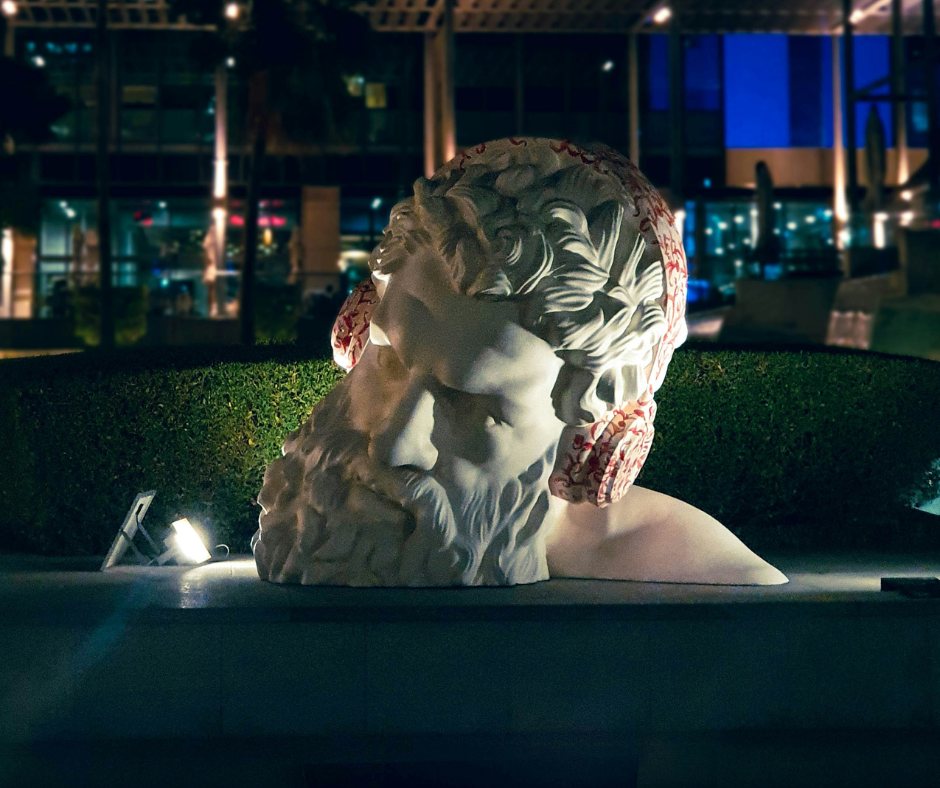
It was taken in the Museum of the Future in Dubai