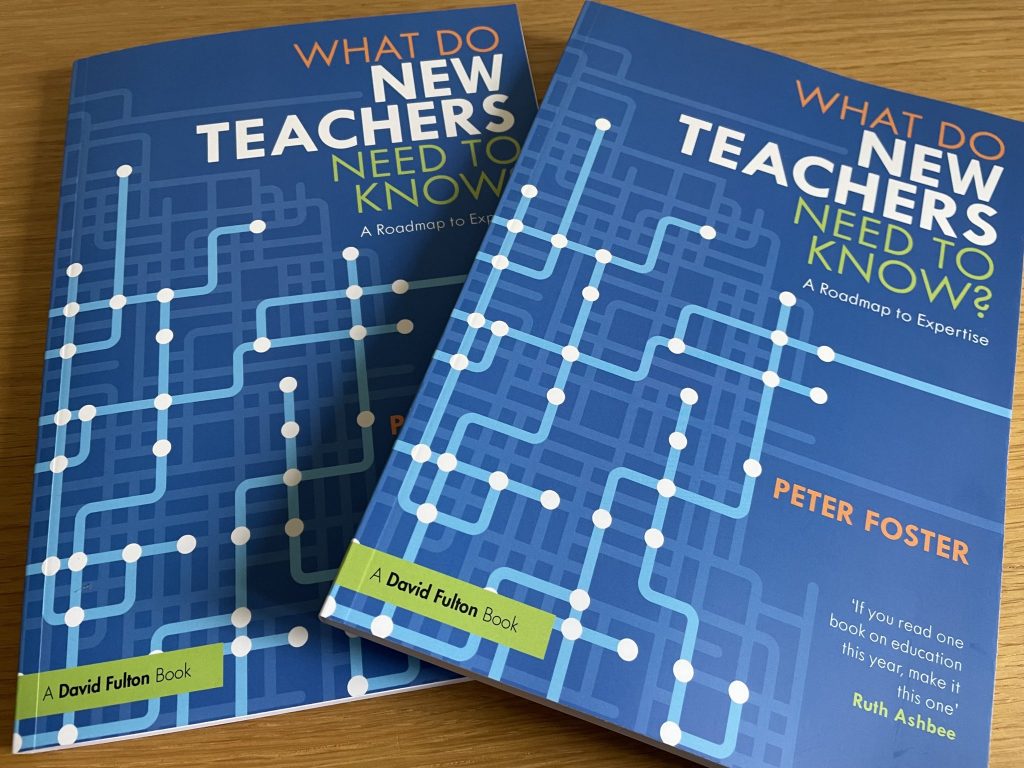
How fortunate today’s new teachers are. This might seem like an extraordinary thing to say, given the recruitment and retention crisis and all that, but I mean every word of it. New teachers entering the profession today have a wealth of materials available to them that should make their transition from novice to expert far smoother than it was back when I trained and few books illustrate this better than a book called What Do New Teachers Need to Know? by Peter Foster.
I purchased this book as a gift for the newly-trained teacher who has taken over my previous job in my local comprehensive. Not only is it superbly informative, it is beautifully written and easy to read. From the very first line, “I didn’t enjoy teaching to start with,” the humility and frankness of the author shine through. He talks of the Monday morning dread, the reality of teaching That Class and how it all “stemmed from this feeling that teaching was something you just had to figure out, a blisteringly frustrating game of Snakes and Ladders where every triumph was followed by a setback.” This was so achingly familiar that what had started out as a cursory glance over my purchase turned into me settling down to give the whole book my full attention.
One of the most radical things about Foster’s book is it values domain-specific knowledge over skills and argues that teachers themselves require an ever-increasing bank of concrete knowledge to draw upon. This does not mean that the book is fanciful or theoretical, rather that it questions the assumption that teaching is dark art, which only the most experienced wizard can practice, rather than a bank of shared knowledge that can be tapped into. Of course, teaching requires practice and nothing can beat a number of hours at the chalkface in the same way that a pilot’s flying hours are relevant to his or her assumed level of skill; but observation, imitation and repetition of good practice allows processes to become automated and innate, freeing up one’s working memory to cope with a greater number of variables. I will never forget having to write down every word I said and every single thing I had to do the first time I stood in front of a class. As time passed, I no longer had to think deeply about certain basic processes because they had become automated. Foster likens the start of a lesson to the opening of a chess game – not because it requires great strategy, but because it is the knowledge of opening gambits that empower the player to make the right moves.
One of the most frustrating things about teaching as a profession is how little focus is given to knowledge at INSET. For a profession focused on imparting knowledge, we do ourselves no justice by neglecting it in ourselves. Foster explores the different areas of knowledge that an effective teacher should be working on at the beginning of and throughout their career, from curriculum through pedagogy and behaviour. His chapter on behaviour focuses on the need for clarity and gives explicit examples of the language that should be used when issuing instructions, expectations, warnings and sanctions. He even gives examples of the questions that a new or inexperienced teacher could ask of their colleagues, something which I have rarely if ever seen suggested: my recollection of training was being told to ask questions, but nobody had any suggestions or examples of what it was I should be asking. For some teachers new to the profession, the whole process can be so overwhelming that they do not know where to begin, so to encounter books such as this which demystify the process is an absolute wonder.
Foster addresses what it means to “know your students” with a level of specificity I have also not encountered before. He explores the limits of our knowledge and looks into how a knowledge of individuals as well as how children learn in general can be of use in the classroom. He counsels against the assumptions we can make that lead to biases in the classroom, something which has always concerned me as a professional. “By paying lip-service to groups of students and gaps between them, teachers and schools can entrench biases rather than topple them,” he warns. It was not so long ago that I was being explicitly told to do things such as mark Pupil Premium students’ books first and indeed to sit them at the front of the classroom. Foster makes the case for equitable treatment and an avoidance of assumption.
Peter Foster has generously shared much of his knowledge for free on his own website, but I would highly recommend any new teacher or indeed any experienced teacher investing in this book. You can buy it here.